Showing posts with label folding bikes. Show all posts

Wednesday, 2 August 2017

A Bickerton Portable Folding Bike


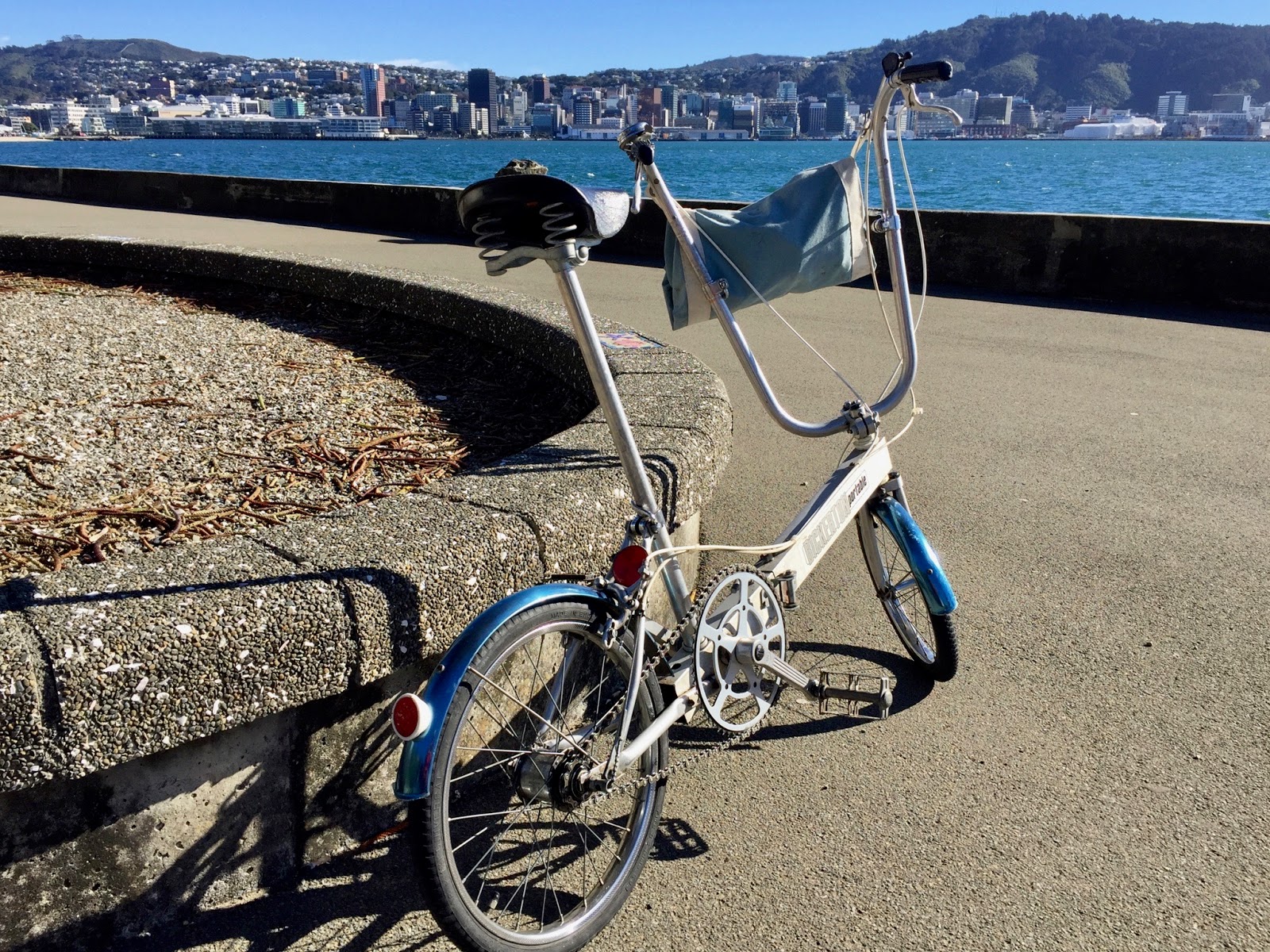
On Friday 21 July, Folding Goldies friends Sue and Gottfried called in to see John. Gottfried deposited a bag in our hallway, containing a very old, disassembled, folding bike. “I thought you might be interested in having a look at this”, he said. “I acquired it recently in exchange for a bottle of good whisky”.

It was a Bickerton Portable Folding Bike. Gottfried didn’t actually say “Can you fix it for me?”, but that is what eventuated. John spent the rest of the weekend taking most of it apart, servicing it, and putting it back together. He researched it on the internet and found out that it had been made in 1979 – so it was 38 years old.

The Bickerton Portable Folding Bike – 1979 vintage (photo by John)

He took it for a test ride around the corner on our street, but he found it wasn’t very good on the hill. So, a bit more tweaking, and by Monday, he tried it on Te Ara Tawa, a nice smooth, mostly flat path. He was satisfied that is was a reasonably viable bike on the flat.

Test ride in Tawa

A couple of days later, after a few more tweaks, we went for a ride along the Wellington Waterfront, so that he could test it some more. Having folded it to put it in the car, he found that it took quite a bit of fiddling to unfold and get it ready to ride. The bag that the bike came in was designed to be folded and domed so that it could hang off the handlebars, which was useful for carrying a spanner. If you were a London commuter trying to take this bike on the tube, it would definitely not fold and unfold in a jiffy!

One fold undone …

That spanner came in handy!

Now the handlebars have to be turned out …

… and adjusted

Done! Ready to roll!  (photo by John)

The Bickerton and my Giant parked together at Karaka Café (photo by John)

After the ride, he made an addition to the bike to give the handlebars a bit more rigidity, which would also stop the cover of the bag from lifting and flapping in the breeze.

A bar between the handlebars made them a bit more rigid.

A few days later, Gottfried came to collect his Bickerton. I think – I hope – he was happy with what John had done with it.

Of course John has written up the Bickerton on his website, which you will find here.


Monday, 13 April 2015

Bicycle Origami Ride


Only a few days after we returned from our big bike trip to the Nelson region, on Sunday 22 March, we took part in an organised ride for folding bikes, or, as the publicity described it, “A convivial ride for ‘Bicycle Origami’ practitioners”.

The ride was organised by Simon Kennett (one of the Kennett Brothers, authors of many books on cycling), who works for the Greater Wellington Regional Council as a consultant to improve conditions for cyclists in Wellington, and Patrick Morgan, spokesman for the Wellington Cycling Advocates Network.

The plan was for people to meet at the Wellington railway station and to take the train to Pukerua Bay, and to bike from there through Pauatahanui and Whitby back to Tawa. We had done this ride before, and we had signalled our intention to take part before we went away down south.

When the appointed day arrived, it was wet and dreary, and not a particularly nice day for a long bike ride. Still, we had committed to it, so we went. We joined the train at the Takapu Road station in Tawa. We were surprised that there were 12 other cyclists and bikes on board. As we got on, the guard told us to fold our bikes, as officially, there is room for only three regular bikes in each carriage. Fortunately, it being a Sunday and with few other passengers, he was not too fussy.

A train carriage full of cyclists and folding bikes (photo by John)

On arrival at Pukerua Bay, it was interesting to see what other types of folding bikes were there – a couple of Bromptons, some Dahons, some Terns, and some (I think) Kiwi Stow bikes, and then of course our electric SmartMotion bikes.

Before we set off, Simon welcomed everyone, and mentioned that this might be the last annual folding bike ride event, as ­– he said – folding bikes were becoming much more common now. Then Patrick gave us a short spiel about safety, and making sure nobody was left behind.

Many different folding bikes on the Pukerua Bay platform (photo by John)

From Pukerua we biked down the hill, past Plimmerton and onto the Camborne Walkway and on towards Pauatahanui, where we stopped at the Ground-Up Café for lunch.

A string of cyclists along the Camborne Walkway (photo by John)

A brief stop at Motukaraka Point (photo by John)

Then, rested and stomachs satisfied, we continued on to Whitby, with its very nice cycle/walkways, and onto the Bothamley Pathway. This is a lovely track through a forest, alongside a stream. Most of the other people had not been here before.

Patrick and Simon, riding Dahons, in Bothamley Park (photo by John)

Riding on the grassy part of the Bothamley Pathway
(photo borrowed from the Greater Wellington Regional Council’s Facebook post)

Waiting for the last people to catch up at the end of the Bothamley Pathway (photo by John)

When we got to Porirua Station, the weather deteriorated again. The rain had all but ceased when we stopped for lunch, but now it really started to set in again. The plan had been to bike to Tawa, and for the rest of them to take the train back to Wellington from there. However, with the rain, they decided to get the train from Porirua.

John and I however – mugs that we are – stupidly decided that it “wasn’t that far” (in fact it's 7 km!) to get back to Takapu Road, where our car was parked, and we were going to make a run for it. Well, we hadn’t gone 500 metres down the road, when the rain came sheeting down, and we were saturated within seconds!

Too late to change our minds now, so we cranked the e-assist up to the max, and we beetled down the road back to the car in the driving rain! Nuts!

But it had been fun to meet some other Wellington cyclists, and we thanked our lucky stars that we didn’t get that kind of weather while we were on our Nelson trip.

Thursday, 25 September 2014

Folding Goldies ride - Waikanae to Peka Peka


Yesterday we went on another Folding Goldies ride. This time, the plan was to take the train to Waikanae and ride to Peka Peka, and back, and return by train before the 3pm deadline (so we could use our Gold Cards, and travel for free).

We had a fine-ish day for it, though quite windy. But compared to the rain, hail and bitterly cold southerly gales we had on Monday, this was bliss. We boarded the train at Takapu Road, and were met by Alastair – the instigator of the Folding Goldies – and Daryl. John B would meet us in Waikanae.

It takes an hour to get to Waikanae, and the time was pleasantly spent chatting and comparing folding bikes. Daryl, who is rather tall, has a folder with quite large wheels, and an enormously high seat (or so it seemed to me). He and Alastair were talking about his “Animal”, and I thought “is this a nickname, like calling a motorbike ‘The Beast’?”. But it turned out that the brand name of this bike is actually “Airnimal”, and it comes with its own suitcase for easy transport (with room to spare for clothes and other paraphernalia for a longer trip).

I had a look at the website and it seems to me to be rather less convenient to fold than ours, as you have to take the front wheel off, and then attach it to the wheel mount after you’ve folded the frame, and you have to take off the handlebars as well. But Daryl seems to enjoy it – he uses it as a commuter bike all the time, and hasn’t needed to fold it yet.

At Waikanae we were met by John B, who had biked up from Paraparaumu, where he lives. We briefly debated whether we would ride the north or south bank of the Waikanae River, and where to stop for morning coffee.

Group photo at Waikanae station – from left: Alastair, Daryl, me, John B (photo by John)

We decided on the north bank of the river and coffee at Waikanae Beach village. I noticed that Daryl was wearing a sunhat rather than a helmet – he has an exemption certificate which allows him to do so. (Bicycle helmets have been mandatory in NZ since 1994, and violating the law can result in a $55 fine.) Note: See Daryl's comment at the bottom of this post.

And here we go (photo by John)

We pulled to a brief stop when Daryl had to answer a phone call from work: “I’ve taken the day off to go for a bike ride in Waikanae” we heard him say. Good to get your priorities right!

Daryl takes a phone call. He’s looking quite sartorial in his suit, sunhat and white gloves!
(photo by John)

From a ride along here a year ago, I remembered the north bank track having to go through a stretch of private land where the track deteriorated to a narrow rut through grass, but we didn’t strike that this time. It must have been where the construction site for the new Expressway is now.

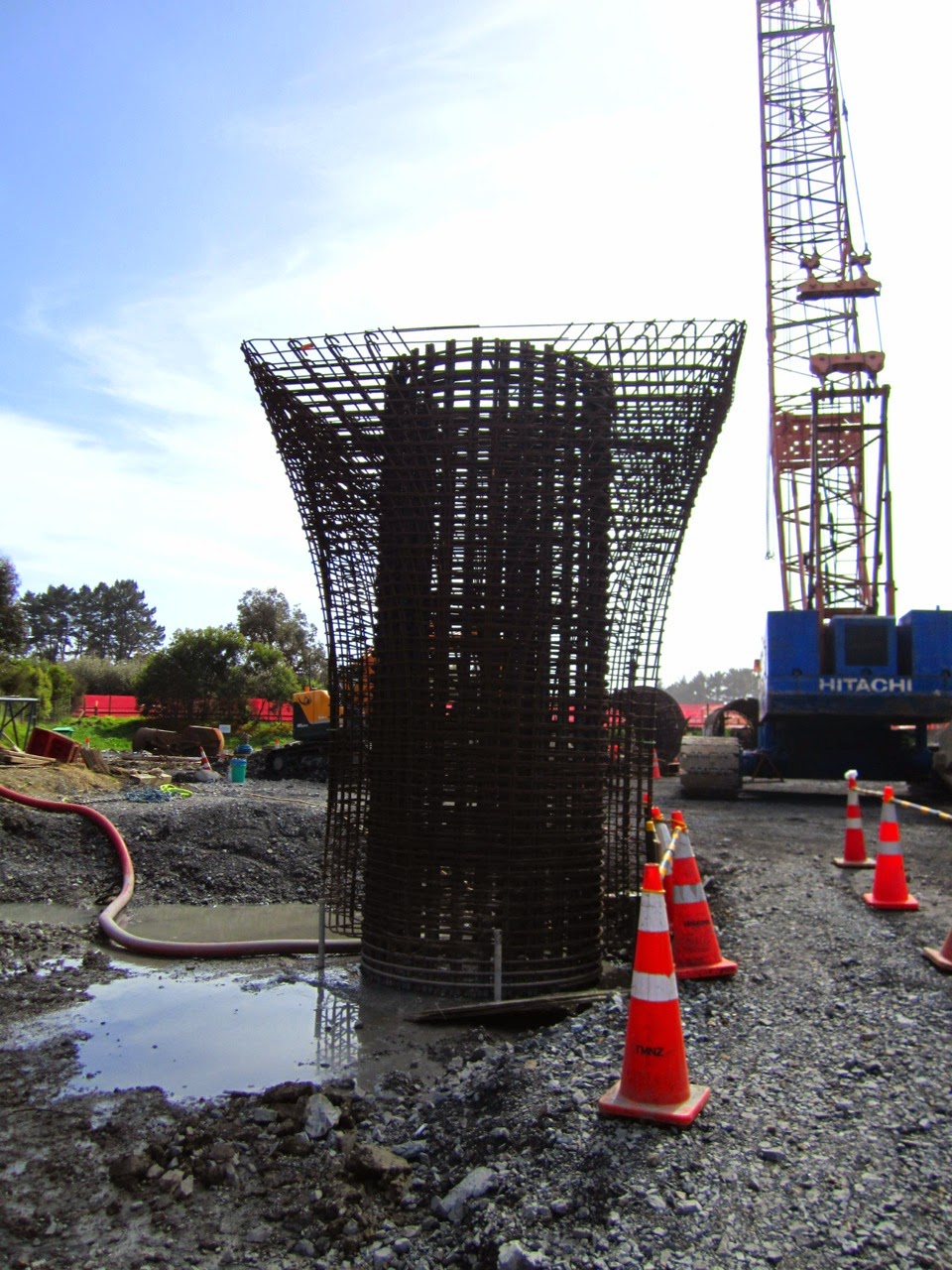
I took some photos through the fence surrounding the site. Some of the steel mesh reinforcing cylinders for the enormous pillars for the bridge were lying on their sides, and some had already been installed with their flared collars.

The reinforcing for the pillars to support the Expressway bridge

One of the installed pillars and its flared collar

At the estuary of the Waikanae River, the whitebait season appeared to be in full swing. At intervals along the edge were people minding their nets. I tried to take some photos of these idyllic scenes, but my camera misbehaved. I had three tries, and the ‘picture’ came out completely blank each time. I fiddled with the settings, then gave the camera to John to see if he could solve the mystery. He tried to take a photo and it worked fine! Aargh! that is so annoying, when something misfires for me, but then it works fine for him, without him actually having to change anything!

This is John’s photo of the whitebaiters. I reckon mine would have been better! (photo by John)

We stopped for coffee at the Long Beach Café on Tutere Street. We were amused at Daryl's way of discouraging any attempt to nick his bike: he simply took off the seat post and took it with him into the café.

Daryl's "security system" (photo by Alastair Smith)

After a leisurely coffee, we headed off towards Peka Peka. There was a strong nor’-westerly blowing, and it was a bit of a slog to ride into it. Before the Pharazyn Reserve (which used to be oxidation ponds but is now being restored to wetlands), we diverted off the road onto a short track that led through the sand dunes, with an option to end up at the beach. We kept on the track that ran more or less parallel with the road to Peka Peka. It was a bit more sheltered from the wind, but it did go up and down quite a bit.

The track through the sand dunes (photo by John)

Despite the headwind, it didn’t actually take us very long to get to Harrisons Garden Centre, where we had decided to have lunch. John B just had a cool drink, then left us as he was biking to Otaki, where he had to attend a meeting. He said he would have to ride on SH1 for a couple of short stretches. That would not appeal to me very much. I feel safe enough now to cycle on quiet roads, but a state highway, without much of a shoulder, would worry me.

Peka Peka Road, approaching Harrisons (photo by John)

Lunch passed very pleasantly with talk about bikes, electric bikes and places people had been cycling – both in NZ and overseas. Alastair has recently invested in an electric bike, which he wrote about on the Cycling in Wellington website, and since then John has been reading up about them, so there was a lot of information to be exchanged.

The ride back to Waikanae was great, with the wind now behind us. Alastair had thought we could perhaps ride on the hard-packed sand on the beach while the tide was out, but upon investigation, it turned out that the wind was whipping up the sand and making things unpleasant.

Anyway, as it was nearly 2pm, I reminded the guys that we didn’t have time to muck around if we wanted to catch the 2:30 train back to Wellington. So we pedalled along at a fast pace. Daryl rode ahead and we soon lost sight of him.

To save time, we rode along Te Moana Road, instead of along the river track, and the last 500 m – up an incline! – were a race against time. Alastair, John and I got to the station with only one minute to spare, and expected to see Daryl there, but he was nowhere to be seen. The train left without him. Alastair managed to get hold of him on the phone, and it turned out that he had taken the river track, and got to the station too late. He caught the 3pm train back and was still able to use his Gold Card.

On the train there was more bike talk between John and Alastair but I tuned out for a bit as I was feeling really tired. I did notice, while idly looking out the window, that there was quite a haze over the sea and that we could only barely see Kapiti Island.

It had been a nice ride (29 km), and enjoyable social time. We discussed where we could take the next Folding Goldies ride. Alastair suggested taking the train to Upper Hutt and riding the Akatarawa Road to Waikanae, and train back from there. John is keen, but I’m not so sure. It will involve a fair bit of climbing. “No more than one or two kilometres of uphill walking”, said Alastair. Yeah right! That’s 1.95 km too much to my way of thinking. But John suggested we go and drive the route sometime, to see how bad it really is. And check out Staglands for lunch, of course!


Sunday, 17 August 2014

A short Hutt Valley ride


Yesterday, we had a short-ish, late-start ride. We rode from Seaview up the Hutt River Trail, as far as Avalon. The weather was fine but there was a cold wind and I was glad of my windproof parka.

When we rode past the Hutt Riverbank carpark, we caught the end of the weekly market. We were just a bit too late to buy anything, as most of the traders were in the process of packing up, and the clean-up crew was waiting to move in. By the time we rode past there on our way back, the carpark was empty, except for a truck driving around, sweeping up all the vegetable left-overs. A large group of scavenging seagulls was squabbling over the remaining debris ahead of the truck.

The track towards the far end of the Riverbank Carpark (photo by John)

At Avalon, we turned off the River Trail, and headed into the High Street to have coffee at the Janus Bakkerij. We enjoyed their excellent coffee and lemon cake (me) and apple crumble (John) in the sun. Then we pedalled along into Lower Hutt for John to make a brief stop at Jaycar.

While I was waiting outside with the bikes, an elderly gentleman stopped to ask whether the small size of the wheels affected the bikes' speed. He said he had a folding bike with larger wheels than ours, that he had been riding for a decade. But, he said, he also had an electric mobility scooter. Then he climbed into his aggressive-looking 4WD, and drove away. What a dude! Obviously covering all his options ...

From here we made our way back to the River Trail, and headed back to our car at Seaview. It was just a short, undemanding ride – just 14 km – but enjoyable.

Today, Sunday, would have been a much better day for a long ride, but I had something else on. While I was out with the car, John took the opportunity to line up all three (!) of his bikes in the garage, and take a photo to show how similar the riding positions are for all three. In other words, nothing is compromised when riding a folding bike.

Then he went for an 11 km ride around our hilly suburb by himself. I won't join him on these escapades. Having to struggle up a hill to get home is not my idea of fun – I’m a flatlander, after all!

John’s three bikes – The folder in the front, his old Tarini mountain bike in the middle, and at the back, the Jamis Allegro Sport he gave himself when he had reached his 1000 km milestone (photo by John)


Sunday, 10 August 2014

Kilbirnie, Hataitai and Roseneath – and a new milestone


The weather has been less than exciting in the last couple of weeks. John was getting a bit stir-crazy, so when the skies started to clear on Saturday, he said he was going to take the bike on the train into town and ride along the waterfront. Although I had plans to go to an SCD dance in the late afternoon, I decided I would quite like to go biking as well.

I had a vague feeling that John thought I was crashing his one-man party, but anyway, we drove to Oriental Parade, and biked to Kilbirnie, where he wanted to have a browse around Burke’s Cycles. It was cold with a brisk southerly, especially around some of the points approaching Evans Bay, but we were dressed for the conditions, with umpteen layers of clothing.

At Burke’s we looked at the latest in folding bikes, including an electric folder, the Flying-Cat Wynd. In bright red, it looked like my kind of bike, but with a pricetag of over $2000, and a hefty weight of 21 kg (compared with 13 kg for our bikes, including bag carrier and bag), it is probably a “no-no” – for now, at least. As John says, maybe in a few years’ time, when the technology is better and our bodies are crappier …

Actually, on the return journey, I would have welcomed the kind of assistance you get from an e-bike. John decided we would go up into Haitaitai Village. I balked – I didn’t want to go uphill! He tried to entice me with coffee at a café at the top of Moxham Avenue. I knew it wasn’t a very good café, but I figured I wouldn’t grizzle since this was his ride (that I had crashed). As expected, we didn’t like the look of the café enough to stop there, and I thought we would ride back down the hill and return along the waterfront.

Wrong! “We’ll just go along here a bit further” said John. “No, I’m not going up that hill!” It was a steep one. “No, not there, we’ll go round the corner, it’s not far.” Well, it was not far – to get to a stretch that was steeper than I could manage! – and I ended up having to get off and push. Grumble, grumble. No sympathy from John. “Serves you right for hi-jacking my ride”. Ooh, ouch!

We got to where it looked like we might be starting to go downhill, and I stopped to take a photo of the airport, just to show how high up we were.

Wellington Airport

We tootled down a short downhill stretch, and then went uphill some more! Too steep for me, so more walking. “It’s not far” and “Come on, it’s not that steep” were John’s encouraging comments. But look at the photos, and see how high above Evans Bay we were. It must be said, though – the views were gorgeous!

Above Evans Bay, looking at the Miramar Peninsula

Above Balaena Bay, looking towards the Hutt Valley

Eventually we made it to Roseneath, where we started going steeply downhill back to Oriental Parade. Here is a map of where we rode, and there is a profile at the bottom, which shows the gradients of the road. I worked out the uphill bit to average about 1:38.

It was well past lunchtime by now, and we continued along Oriental Bay to Karaka Café for coffee and a bite to eat. The cafe was very busy and we enjoyed sitting in the sun, waiting for our food to arrive. We watched a couple of rowing crews returning from their training session, and getting their craft (coxed four?) out of the water, and hoisted up onto a trailer.

Karaka Café was busy
Rowing crews return from their training session

Before returning to the car, we rode along to Queen’s Wharf, as I needed to have a mileage of 15 km today, so that I could reach my 2000 km milestone. There was a market on in the Frank Kitts parking garage, and there were a lot of people about enjoying the lovely day. We stopped to listen to a man playing some boogie-woogie jazz on the community piano. He was very good.

A cyclist plays on the community piano near Frank Kitts Park

We had another look at the new Clyde Quay Wharf, and rode right round it. There are no retail businesses on the ground floor yet, but it looks like two food places – Mojo's and The White House –  and a Day Spa/Beauty Parlour will be opening there soon. It is all pretty stylish, and would be an interesting place to live – though eye-wateringly expensive.

The far end of the Clyde Quay Wharf

Then, just as we were coming back off the wharf, my bike computer showed 15 km, so I had reached my 2000 km milestone. Which warranted a photo, of course!

2000 km! (photo by John)

Back at the car, John said he wanted to stop at Bicycle Junction, the bike shop in Newtown, as he wanted to take a look at the Brompton folding bike  which they now import. John has been fascinated by these incredibly nifty – but expensive – folding bikes, and wanted to see a “live” one (as opposed to online).

The man in the shop – Dan Mikkelson, I think – was very helpful and showed us how quickly you can fold and unfold this lovely bike, and what a neat small package it folds down to. The back wheel folds underneath the frame, and has a little stand with rollers so that it is really easy to wheel the bike around in its folded state – useful if you have to drag it around a railway station, for instance. Or if you have to take it on the Tube and park it under your desk at work – as a London-based friend of mine does.

We have been following the blog of the Cyclopolitans, a NZ couple who are travelling around Europe on their Bromptons – with trailers!  Very interesting and inspiring. I would love to do something like that, but without the camping. I like my creature comforts!


Tuesday, 22 July 2014

Inaugural ride of the “Folding Goldies”


Just over a week ago, we received an email from Alastair Smith (I mentioned him in my blog post of 6 July) , announcing the formation of a new group – the Folding Goldies. “Now that I've acquired a Gold Card and a folding bike, I'm forming a group of people who can take advantage of these to do trips in the Wellington Region”, he wrote. He’d even created a new website for the group.

He suggested an inaugural ride, which would involve taking the 10:35am train from Wellington to Upper Hutt, cycling down the Hutt River Trail back to Petone, and then taking the train back to Wellington.

That sounded like a great idea. We emailed back to let him know we would love to take part, and that we would catch that train at Petone, as it is easier for us to park there than in town.

The date suggested was last Friday, which turned out to be freezing cold, windy and wet! Under normal circumstances, we wouldn’t have ventured out on a day like that. But we had committed to it, so we bundled ourselves up in multiple layers of clothing – thermals, merinos, parkas – and headed down to Petone.

From the bottom of Ngauranga, we could see that the brisk southerly was whipping the harbour into choppy peaks, and the Hutt Valley was shrouded in low cloud.

While waiting in the car at the foreshore carpark, we watched as the waves splashed onto the shore. Rain slapped on our windscreen. A large group of seagulls hovered above the surf. They seemed to be trying to fly into the wind, but were making no headway at all. I questioned our sanity to be going out riding on such a miserable day. But we braced ourselves, pulled out the bikes and rode the short distance to the Petone Station.

Petone Railway Station (photo by John)

As we boarded the train, Alastair greeted us with a cheery “Welcome!”, but then we had to get off again, because the designated cycle area in that carriage already held three bikes (the maximum allowed). Luckily there was another carriage that had room for our bikes. We could have folded up our bikes, and had them in the same carriage as legitimate “luggage”, but going to the next carriage was simpler.

Once off the train at Upper Hutt, we posed for the inaugural group photo. The turn-out was a little disappointing: apart from us and Alastair, there were only two others – John B and Russell. Still, it’s a start; let’s hope the next ride will include a few more people. And as Alastair mentions on the website, people who do not own either a folding bike or a Gold Card are still welcome to join the rides. In fact, Russell was riding a regular-sized mountain bike. It was interesting to see the other folding bikes: Alastair’s was a “Tern” and John B’s was a “Dahon”.

Well wrapped against the elements. From left: Désirée, John P, John B, Russell, Alastair
(photo by John)

As we had done this ride before, John led the way through the Upper Hutt streets to the River Trail. We joined the trail near the Totara Park Bridge, where traffic lights make for a safe crossing of SH2 (River Road).

Fortunately, by this time, the rain had almost stopped, but the cold wind persisted. The gravel track was quite wet still, and there were plenty of puddles to negotiate (around or through). Our bikes and trouser legs received a good dose of mud spatters.

I was surprised at how leisurely the ride was. I was expecting these three very seasoned veteran cyclists to set a blistering pace, but thankfully they were not in too much of a hurry. We didn’t make any stops, except when we had to manoeuvre our bikes through pesky gates. No photo stops either, though John rode ahead and took a few photos of us as we were riding past.

John B, Russell and Alastair on the track below the Eastern Hutt Road near Stokes Valley
(photo by John)

We turned off the River Trail at Avalon Park, and pedalled through suburban streets to get to Janus Bakkerij in Lower Hutt for our lunch stop. We’d been cycling for just under two hours. The café was very busy, but our lunches and excellent coffee were delivered quite quickly. During lunch Alastair decided that, as he was going away for the weekend, he had better take the train back to Wellington from here rather than from Petone. Conveniently, a train was due to leave in ten minutes from Epuni Station, just down the road. The other two ended up doing that too.

Lunch at Janus Bakkerij (photo by John)

So that left just John and me. We finished our coffees, then biked back to the River Trail, and completed our ride to Petone. We rode 32 km in all, and despite the rather inclement weather, it had been very enjoyable. It was good to meet some other cyclists too.

Alastair has put a link to more photos in his post-ride report, on the “Folding Goldies” website.


Monday, 6 January 2014

About the bikes

I have just done a whole lot of "fiddling" with my blog. I have added a list of Keywords along the left side of the page to facilitate finding topics of interest. I have also shifted a few entries that were in the "Other Stuff" page to the main page, even though they are not about cycling, but about some of my other interests.

On John's suggestion that some technical information might be of interest to some people, I am adding below a pared-down extract from his webpage, about the Giant Expressway 2 Folding Bike. This also allows me to add some useful technical keywords to the list.

Giant Expressway 2 Folding Bike (by John Patterson)


Introduction


The Giant Expressway 2, 2013 folding bike is the latest folding bike from Giant. The bike is intended for commuting, where a larger bike might not be permitted on peak hour public transport. The bike is also ideal as a means to explore new places, and to get fit. There are many suitable cycle trails and tracks here in New Zealand.

Twin bikes. Note the higher seat on John's bike in front (photo by John)

I purchased this bicycle as an easy re-introduction to cycling. I got it at Burkes Cycles for $560 which was a standard discount from the retail price of $599. This price to that of a good quality conventional bike so a decision can be made purely on personal needs.

I had not cycled for 13 years because of health issues. The folding bike was perfect as I could put it in the car and take it to somewhere flat to ride. Now that my fitness has improved, I have started using the folding bike for longer rides. It deals well with variable surfaces – I have had no problems with riding it on gravel.

I bought Désirée a bike so she can join me on the rides. Both bikes can easily fit inside our small Nissan Micra car with room to spare for luggage when travelling further afield.

Both bikes easily fit into our Nissan Micra, with room for luggage behind the front seats (photo by John)
 

 Technical details


The components are basic, but sufficient for most applications. So far I have had no problems. The Expressway wheels are quite strong with 36 stainless steel spokes, alloy rims, alloy hubs, and solid axles. Other good points are a Cr-Mo fork, a hydroformed 6061 aluminium alloy frame and a substantial carrying bag. Specifications are available from any Giant web site or dealer.

The bike has a wide range of quick release adjustments for seat height, handlebar height and tilt. Other settings for gears and brakes are finger adjustable. Horizontal seat position, and some other brake adjustments, require a 5 mm allen-key. Wheel removal requires, preferably, a 15 mm ring spanner. Quick releases are not required as the bike fits in a car without removing any wheels. If you have a good local bike shop then none of this will be a worry.

The bike has seven speeds ranging from 70 to 35 Gear-Inches, 5.6 to 2.8 Metres-Development or a 5.24 to 2.62 Gain-Ratio. These terms are defined here. In other words, the lowest gear requires half the effort of the highest gear. Here in Wellington, New Zealand, I can climb most hills with these gear ratios. I can always walk if things get too difficult.

The geometry of the bike has similarities to the classic, and well regarded, Raleigh 20 folding bike. Both bikes have a larger rear triangle than most folding bikes sold today. This strengthens the support for the seat post and the more heavily laden rear of the bike. The seat post is supported, in 4 distinct places, rather than in just the 2 places found on many other folding bikes. The Expressway wheel base is 1013 mm, while the Raleigh 20 wheel base is 1003 mm. The shortest distance from the seat-post axis to the handle-bar axis is the same at about 570 mm. The seat-post and head-tube angles are similar at about 71 degrees. The Expressway chain-stay length is 404 mm while the Raleigh 20 chain-stay length is about 392 mm.

Improvements


I was told that I could not fit a standard carrier on this bike. In fact it was easy to fit, so both bikes now have carriers. They are set back far enough to take my old pannier bags, if needed. I have mounted a small pump under the carrier.

A Cateye bar-end mirror was fitted to each bike. This addition is probably the most important as it contributes to safety. You can see the line that traffic is taking behind you, whether any indicators are flashing, and the approach of other cyclists. I have used a bar-end mirror on my mountain bike since the late 1980s. When riding on busy roads it helps me to assess the space that wide vehicles, such as trucks, would leave me. I filed some plastic off the inside of the end-cap so the mirror tilts out further. This prevents it being knocked by my hand during rides.

A rear-view mirror is added onto the end of the handlebar (photo by John)

On each bike I was able to fit a holder for a 600 ml drink bottle behind the seat, attached to the carrier and its support-stay. The bottle holder tabs were bent slightly to fit and a single 5 mm hole was drilled in the carrier. The triangle thus formed made the carrier-stay more rigid as well. I did not like supporting the bottle horizontally on the frame, in front of the rider as it interferes with stepping over the frame to ride or to dismount.

A bottle holder was added behind the seat (photo by John)
 
I purchased two Cateye Velo 5 bike computers so we can each keep track of the distance travelled. This basic model has trip distance, odometer, maximum speed and a clock. The Velo 8 offers more options, including average speed.

I had some old Lowepro camera bags which were easily mounted on the front handle bars. They can contain items such as locks, sun-glasses, cameras and tire repair kits. These bags have pull-out rain covers.

A camera bag is fitted onto the handlebar. Note also the bell, the bike computer (top right of photo), and the quick-release lever to adjust the tilt of the handlebar (photo by John)

On my bike I replaced the saddle with one with longer mounting rails and better comfort. This allowed me to set the saddle back further so that the set-up was similar to my mountain bike. On Désireé's bike I also replaced the saddle with a more comfortable one.

I have a basic LED lighting set-up for emergencies. I don't anticipate cycling at night.

Tyres


For reference, the Kenda Kwest 20x1.25 inch tyre, fitted on the Giant Expressway 2, is actually 480 mm or 18.9 inches in diameter. The circumference is therefore 1508 mm or 151 cm. The last value should be entered when the bike computers are set up. The measured tyre width is actually 1.39 inches or 35 mm, when inflated. In the front, the tyre clearance is an average of 13.5 mm on each side. In the rear, it is about 6.3 mm on each side.

There appears to be little relationship between the specified and the actual tyre dimensions on many bikes. This means that any upgrading is essentially an experiment. The frame clearance from the tyre wall should not be much less than 3 mm. This maximum measured width of a substitute tyre should therefore be no more than 56 mm in the front and 42 mm in the rear. The particular internal width of the rim can affect the measured tyre width and place limits on the maximum tyre width that can be safely fitted.

After experiencing a few punctures I upgraded to Kenda 912 20x1.75 inch tyres. They ride better on rough surfaces and they also have a good tread pattern for the road. The new tyres are 3.3% larger in diameter so a tyre circumference of 156 cm needs to be used with the bike computer. The chain-stay clearance is about 2.5 mm. Note that the Giant tyre specification is wrong in New Zealand. Here, Kenda 20x1.25 inch tyres are supplied instead of the specified 20x1.75 inch tyres.

Maintenance


The maintenance required on this bike is similar to any other. Keeping the chain clean and lubricated is important. I first use some light oil to penetrate inside the chain. I wipe off the outside of the chain and then I apply some dry lubricant.

On Désirée's bike I removed one shim from the freewheel cassette, as it was a little loose and noisy when ridden. This is a low cost item so replacement is an alternative. The shim removal stopped the noise by reducing the bearing clearance. The cover recently worked loose because I did not tighten it up enough when I refitted it. Using a punch I have tightened it up more firmly. I also used blue loctite 243 threadlocker to assist.

Learning to adjust the derailleur will help to keep the bike running smoothly. It is a simple twist adjustment on the derailleur end of the cable housing. The cable can stretch slightly with time or the cable housing may shorten. To compensate, the adjustment is turned while pedalling the bike by hand, in a middle gear. You may need help to support the rear of the bike off the ground, or you could turn the bike upside down. Adjust for minimum chain noise. Excessive noise means that the derailleur is trying to move the chain out of alignment. Your local bike shop can help.

The brakes may also need adjusting as the brake-pads wear. In this case the adjustment is on the brake lever.

I carry some spares and safety equipment on our trips. This includes a spare tube, a tyre repair kit (including patches and tyre levers), a 15 mm ring spanner, a bike multi-tool, light rainwear, a sun hat, a basic first aid kit, a torch, a lock, a small tripod and a tiny folding kite. We always take water, a sliced apple and some small chocolate bars. I usually have a locality map on my iPod Touch. We both carry cell phones. I keep a larger tool-kit and lubricants in the car.

Conclusion


The bikes are performing well. As I have gained fitness, the urge to upgrade the gearing has dissipated. Much of the recreational cycling, in the first half of last century, including round the World trips, was done by people using 1 or 3 speed gearing. The 3 speed bikes also had less than half the gearing range I have now. I see no need to substitute higher grade bike components for our application.

I have found that off-road loose surface riding is a good way to gain bike handling skills.

When cycling recently in New Plymouth we discovered that the bikes are good in the rain. The carrier, added at the rear, provides spray protection from the rear wheel. The small wheel size at the front means the feet don't get as wet as they do on a standard bike.

The folding bike has provided me with a pleasant way to improve my health. The gains have been significant. In addition, I have been able to explore many areas in my own city that are new to me.


Wednesday, 6 November 2013

Kapiti Arts Trail

Our excuse for a ride on the Kapiti Coast last Sunday (3 November) was the Kapiti Arts Trail. Not that we need an excuse to go for a ride, of course, but this seemed as good a reason as any to go there to ride. We enjoy art exhibitions, and it is good to support local artists.

We parked at the northern end of Waikanae Beach, near the start of Rutherford Drive and headed north, towards Peka Peka. Our first port of call on the Arts Trail was Michelle Retimana’s Studio Garden and Gallery. She’s a potter who makes wonderful pots and garden sculptures, many with a Māori theme. Her work is quite recognizable for the kind of clay she uses, as it is very textured, with gritty bits embedded in it (probably not a potter’s technical description).

I do like Michelle’s work, but didn’t buy anything – somehow it makes me feel as if I am being disloyal to my potter sister if I buy another potter’s work. I also liked the large piece of art in her garden, not pottery, but made from large glass electrical insulators, called, I think, “Asset sales”.

Michelle Retimana’s garden art (photo by John)

We’ve driven along this road between Peka Peka and Waikanae many a time, but never noticed the Pharazyn Reserve. On a bike there is so much more to see and notice. We went into the reserve for a look. It is a wetland area which apparently used to be the sewerage ponds, but is now being rehabilitated. There is a children’s playground by the entrance, and there is a track that goes some distance around the pond, and it heads up a sand dune, but peters out after a hundred meters or so. The development of the reserve is a work in progress, I think. There is a jetty but no boating activity. Perhaps it is a left-over from the sewerage pond days.

Pharazyn Reserve (photo by John)

Riding a longish distance on the road – as opposed to a cycle track – was new for me, but I felt OK about it as there was not much traffic. We called in at another couple of artists’ studios, and then made our way to “Harrisons”, the garden centre at Peka Peka. It has a very nice café, which is often our morning tea stop if we are driving North.

We parked our bikes in the bike rack next to the terrace. While we were waiting for our lunch, a group of cyclists arrived, who looked over our bikes while parking theirs. With their much smaller wheels, our bikes do look very small next to their “grown-up bikes”. We noticed, when we were about to leave, that two of their bikes were also folding bikes (Dahon), but with rather larger wheels than ours.

Our little folding bikes look so small next to their "grown-up" bikes! (photo by John)

After a satisfying lunch we returned to Waikanae, but first we called in at a studio where four artists were displaying their work. Two painters, and two potters. One of the potters, Wendy Masters, also had some delightful small bronzes.

One of these really took my fancy, so I decided to buy it. It is quite small – the bronze part of it is only 8cm high, sitting on a heavy pottery base 5 cm tall. The shape of a horse on it was inspired by early man’s cave paintings, Wendy told us. The back of it also has a horse on it. I’m feeling very chuffed with my purchase.

My purchase: a small bronze by Wendy Masters (photo by John)

The terrain we were riding through was undulating – basically sand hills – but because the surface was smooth, I didn’t find it too hard.


The road went up and down a few rises (photo by John)

The track to Peka Peka Beach (photo by John)

Back at the car, we loaded the bikes back in, and drove to the carpark by the Waikanae River estuary. Then we rode around the Waimanu lagoon, where we rode a month ago, but didn’t do the whole loop.

The lagoon is home to a large number of species of water birds. A gaggle of geese were in pretty much the same place as the last time we saw them, and their goslings, which were tiny then, are now quite a lot bigger. We also saw some black swans with their fluffy grey cygnets.

The goslings (in the foreground) are a lot bigger than a month ago (photo by John)

A pair of black swans and their cygnets

Other birdlife we saw were the pied shags, nesting in the a tree near the lagoon. They have a toxic effect on the trees they nest in, as the photo below shows. Their droppings eventually kill the tree. Apparently this colony of birds has been growing over the last few years, and the residents of the houses nearby have had to put up with the resulting noise and smells.

The nesting shags’ droppings eventually kill the tree (photo by John)

A close-up of the nests shows several nests that have what looks like two adults and one nearly grown chick in them.

Nesting pied shags with chicks

We saw several juveniles sitting at the water’s edge. I noticed that the skin under their beaks was quivering as if they were calling out, but we could not hear anything. Perhaps it is so high-pitched that human hearing cannot detect it?


A juvenile pied shag (photo by John)

After riding a loop around the lagoon, we headed up the track along the river. It is a really lovely track, very enjoyable to ride on. It goes through bushy areas and more open areas near a pony club. A white horse in a paddock full of white daisies looked so idyllic, it reminded me of a unicorn; it ought to have had a horn on its forehead.


The track on the north bank of the Waikanae River (photo by John)

A unicorn without its horn?

At the Te Arawai footbridge, we crossed to the other side of the river and rode back to the Otaihanga Domain, where we found a caravan selling ice-creams. Yay! Just what we needed.


Te Arawai footbridge (photo by John)

After we had enjoyed our icecream, John suggested I try his bike for a bit. After the punctures he had a few rides ago, he had upgraded his tyres to slightly wider ones with more tread on them. He found they gave a better ride on the gravel, but were still good to use on the sealed road surface. So he wanted me to try them out before he upgraded the tyres on my bike.

He had to lower the saddle, before I could ride his bike. I like the handlebar higher than he does, but for this little try-out, we left it as it was. I only rode a few hundred meters out and back on the gravel track, but did find that these tyres seemed to smooth out some of the bumps. John has since been to see Francis at the Johnsonville Bike Shop and ordered a pair for me.

On our way back to the estuary carpark to get the Arts Trail map – so that we could go and look at a few more studios – we rode past a family feeding the ducks and swans, surrounded by a very avid audience.

Black swans galore

A couple enjoying the sun on a bench nearby came over to ask us about our bikes. They had only recently moved to this area, having come from Central Otago. They had cycled the Otago Rail Trail, and heartily recommended it. It is on our “to do“ list – one day.


The Waikanae River Estuary. The posts are to stop cars driving onto the sand and wetland areas
(photo by John)

We rode into the Waikanae streets to visit a few more artists’ studios. Some of the streets were quite steep, and I had to get off and walk, but because they were signposted for the Arts Trail, we persisted. The most interesting studio belonged to potter and artist Pamella Annsouth and her late husband, potter Mirek Smisek. The setting was charming. One enters through a display area, looking rustic and artistic, and as you go up some steps into the workshop space, there is a glimpse through an open door into the living area, which looks very inviting. Pamella’s work is very diverse, many items featuring nudes and people’s faces.

As we were looking around at the work on display, Pamella offered us a glass of orange juice – very welcome, as we had just struggled up a hill to get there – and we chatted. John and Pamella got to discussing the electrics of her kiln.

John is very knowledgeable in electronics, and knows quite a bit about kilns too. He has a small electric kiln that he acquired a couple of years ago to do some consulting work. And he has also been able to help my potter sister with the electrical sensors on her gas-fired kiln.

As they were engrossed in their discussion, I wandered out onto the veranda, where more pots were displayed. The wide sill of the living room window looking out onto the veranda was covered in a multitude of interesting objects – possibly mementoes or items providing inspiration. One of these was a very large piece of turquoise-coloured glass, which really caught my eye – and the sunlight.

The end of the veranda opened out to the view over the estuary and the lagoon, and Kapiti Island in the distance. Absolutely beautiful!

Pamella Annsouth’s work displayed on the veranda

The view from Pamella’s veranda is stunning!

By the time we left this studio, it was nearly four o’clock, the “finishing” time of the Arts Trail. So we had a look at one more, and then we pedalled back to the car. To fill in time before it was “fish and chips time”, we took a walk around the Waikanae town centre and looked in the shop windows. The place was absolutely dead as all the shops were closed.

I peered into the windows of “Fibre Flair” on the main road. In my weaving “yarn-a-holic” days, this shop was one of my favourite haunts, as they stocked lots of interesting yarns. These days, I think the shop caters more for quilters and embroiderers than for spinners and weavers, but I’m pleased to see it’s still in business.

To finish off a most enjoyable day, we had fish and chips overlooking the beach at Paraparaumu. Luckily, the one seagull who spotted us stayed sitting on his fence post, and did not call his mates, so our dinner was quite peaceful.

All up, we rode 31 kms. I was very pleased that I had found it easy. My gel saddle means minimum discomfort in the rear end, and my being able to manage the gears more effectively means that I didn’t have any trouble with the undulating terrain, except for the few steep Waikanae streets at the end. And the gravel track no longer presents any problems for me either.

I’m making good progress. With new tyres, we will continue to do longer distances and more challenging terrain – in preparation for riding the Otago Rail Trail. Maybe some time soon-ish?