Showing posts with label exhibitions. Show all posts

Wednesday, 2 August 2017

Waikanae to Peka Peka – and an exhibition of tapestries


Last week we had a run of four fine(-ish) days in a row, yay! – no rain, no wind. So nice to see the sun after several “weather bombs”. We had to make the most of the good weather before the next deluge, so we biked four days in a row. Admittedly, two of these rides were very short – one was a “café run”, a 7 km ride to down to our local café and back, and the other was the 8 km ride on the Wellington Waterfront to test the Bickerton (described in the previous blog post).

The other two rides were 20 km. One of them was a ride to the Gear Homestead Café, during which I reached my 5,000 km milestone on my e-bike.

5,000 km on the e-bike

We rode along Te Ara Tawa. However, this beautiful track, which was only completed just over a year ago, is now again inaccessible between Kenepuru and Porirua because of the impending construction of the Kenepuru on- or off-ramp for the Transmission Gully Highway. So cyclists now have to either ride on the road again, or use the footpath.

                                                  * * * * * * * * * * * *

On Tuesday 25 July we drove to Waikanae Beach, where we parked near the Waikanae River estuary. We biked on the Kapiti Coastal Cycle Route to Harrisons at Peka Peka. There we had lunch and a wander around the garden centre at Harrisons, then returned to Waikanae on the new Expressway cycle track.

A colourlful display at Harrisons Garden Centre (photo by John)

The junction of Peka Peka Road with the old SH1 is now all tidied up, including access to the cycle track.

Because of the heavy rain we had in the past week, there were areas beside the track that still had standing water, where they wouldn’t normally have, but the track itself was mostly dry – give or take a puddle or two.

Water around fence lines following heavy rain … (photo by John)

… but the track was mostly dry (photo by John)

Some way down the track, we diverted onto a path leading to Smithfield Road. I had sailed past it but John called me back by furiously ringing his bell. The track eventually led to a very lovely stretch of road which turned out to be Ngarara Road. A narrower road went off it and we would have liked to explore further, but it was a private road, so we desisted.

A lovely spot on Ngarara Road (photo by John)

Sadly, this was a private road so we could not explore further (photo by John)

While we were taking photos of the pretty scenery and the peaceful looking cattle, a farmer appeared on the brow of the hill – probably wondering what we were up to.
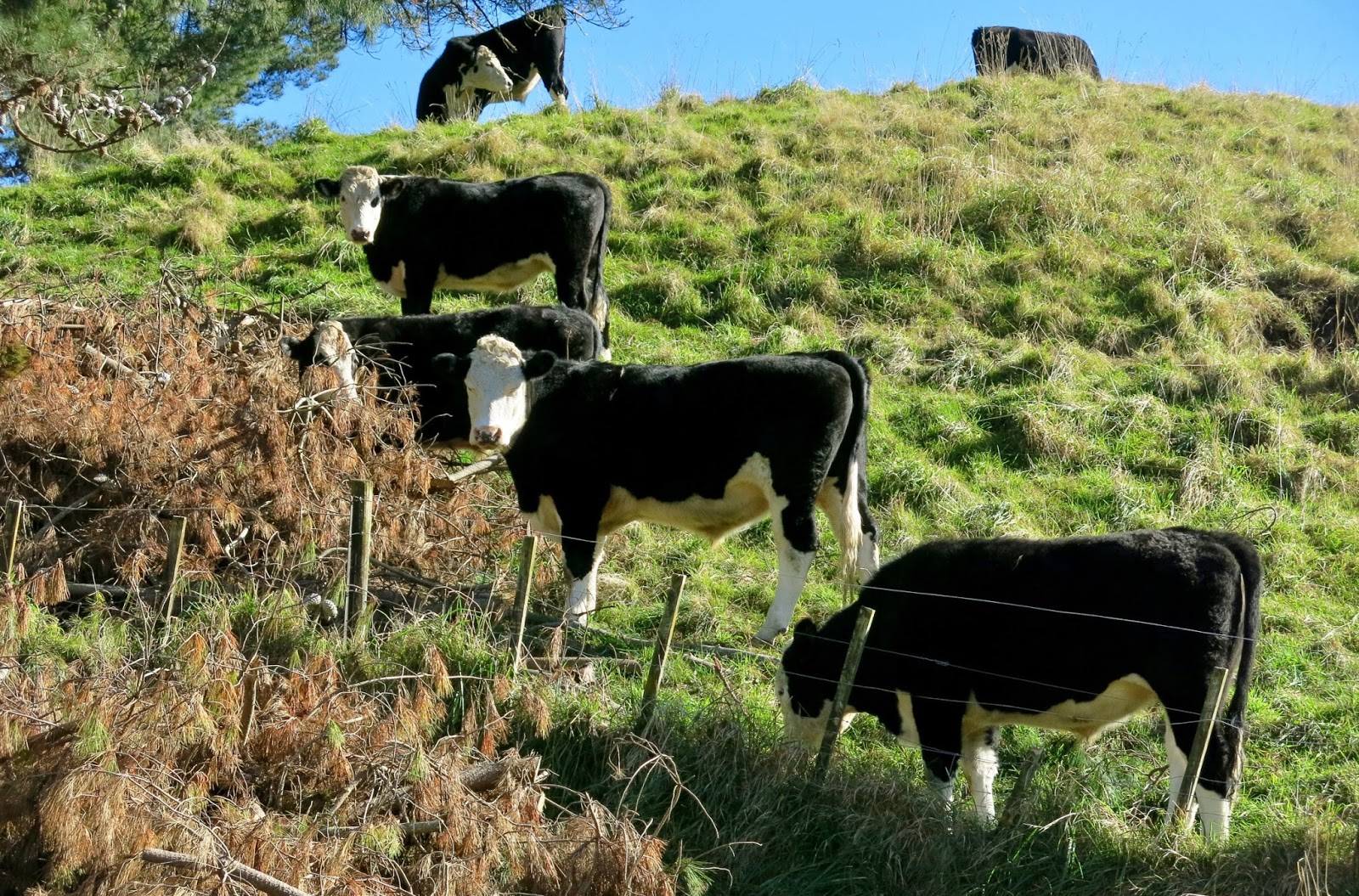
The steers stopped their grazing to check us out (photo by John)

Before long, Ngarara Road became a bridge over the Expressway, and we joined the cycle track again. The road sign pointed to Ngā Manu Nature Reserve, which I think we should visit some time, maybe on another ride. We have been there once, but that was years ago when our children were still young.

At the junction with Te Moana Road, we left the Expressway track, and pedalled back to our car. Though there are still roadworks going on near the junction as a result of the Expressway, most of Te Moana Road has a nice cycle lane.

Roadworks on Te Moana Road (photo by John)

We diverted off towards the river and the Waimanu Lagoon, and sat on a bench, enjoying the sun, the view and some chocolate! While we were sitting there, the time-lapse camera on John’s bike took a picture of us, which I am now using as a computer screen saver. I call it “Retirement Bliss”.

Between the river estuary and the Waimanu Lagoon (photo by John)

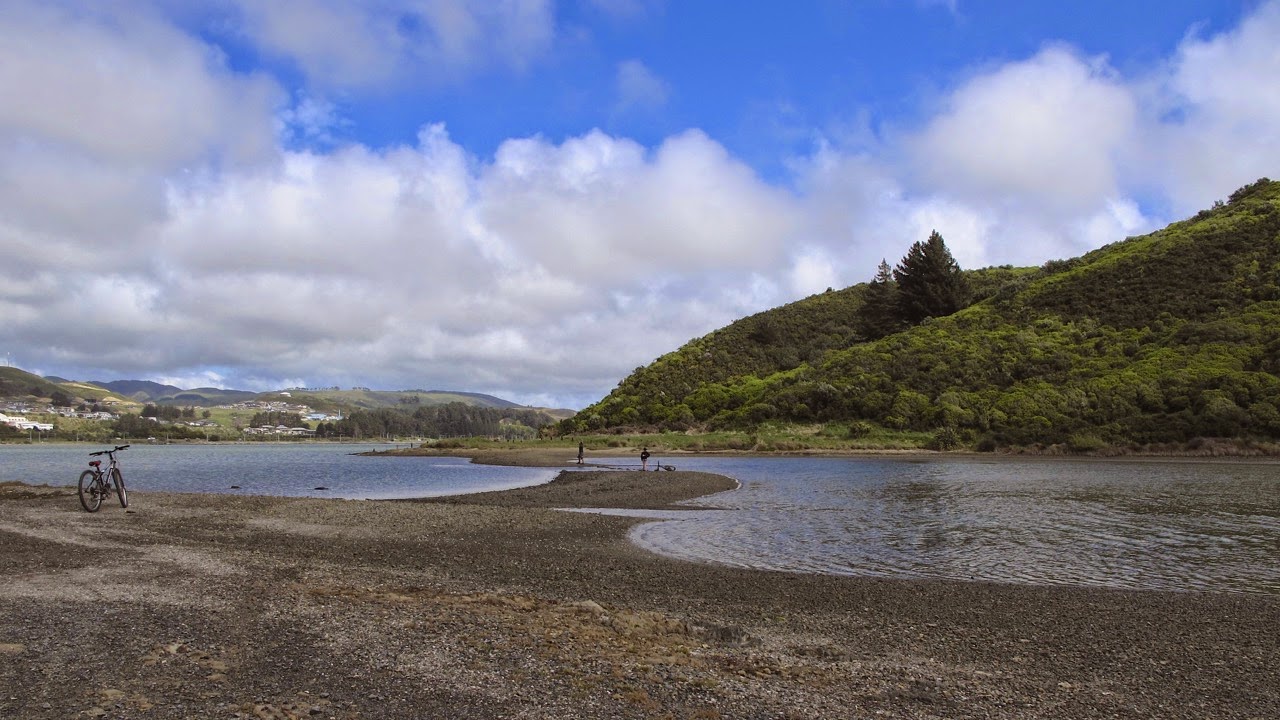
The Waikanae River Estuary (photo by John)

Retirement bliss (photo by John)

                                                       * * * * * * * * * * * *

On the way home, we stopped at the Pataka Gallery in Porirua to view an exhibition of tapestries by multiple award winning Peruvian master weaver Máximo Laura. It is a stunning exhibition. Ten large tapestries are on show, all of which made me “drool”! Máximo has an amazing use of colour and his colour blending is exquisite. I love the vibrant colours and the “clean” lines of his designs.

Fruto de Abundancia del Mar IV (Abundance of the Fruit of the Sea)

Hacia la Amada (Journey to my Beloved)

I love the vibrancy of the colours!

As well as his exhibition in Pataka, Máximo Laura has been conducting workshops for NZ tapestry weavers in Wellington and Hamilton. One of my weaving friends, Trish Armour, herself an award-winning tapestry weaver, spent several weeks studying with Máximo in his Lima studio last year. She alerted me to his works, which I have been following on Facebook.

I would dearly love to own one of his tapestries, but unfortunately they are well beyond my financial reach! So I will just have to make do with the photos on my screen saver.

Tuesday, 31 May 2016

An Exhibition of Ceramics and Photographs


Last night was the opening of my sister Aimée McLeod’s ceramic exhibition, entitled “The Dinner Party”. It features ceramic tableware, which is beautiful and varied. Her statement for the exhibition is:

“Fast food, take away coffees out of paper cups and plastic containers, eating on the run or in front of TV, hurry, stress … part of the daily routine for many these days. Consider instead sitting down with friends at a table with plates and dishes that are worthy of the food and enhance the pleasure of eating.”

The exhibition is at the Thistle Hall, on the corner of Cuba Street and Karo Drive, and will be on until next Sunday (5 June 2016).

Aimée’s exhibition invitation

As part of the exhibition, Aimée invited John and another photographer, Roland Idaczyk, to display their photos on the blank walls of the gallery.

Friday, 19 June 2015

Mangaroa Valley


We’ve been wanting to repeat our ride in Whitemans Valley for a while, but somehow something always got in the way. On Wednesday, we finally did go in that direction, but instead of riding Whitemans Valley, we rode the Mangaroa Valley loop, a bit further north.

We killed two birds with one stone, as it were, as we had to take the battery of my e-bike up to Daryl’s Wellington Electric Bikes shop in Upper Hutt. It had developed a fault and wouldn’t charge up. Hopefully Daryl will be able to get us a replacement.

We decided to bike to the Mangaroa Valley, because – John thought – the hill up to the valley was not as steep as the one into Whiteman’s Valley, and he would be riding his regular bike, while he let me use his battery so that I could ride my electric bike. Isn’t he a gentleman?

As it turned out, the Mangaroa Valley Road was not easier to climb than the Wallaceville Road into Whitemans Valley, and John had to get off a couple of times to walk on the worst bits. Meanwhile, I zoomed forth on my e-bike. Yeehaa! But I did stop to wait for him when he had to walk, needing to make sure he was OK.

While waiting, I took this photo, looking towards (probably) Maymorn.

Nearly at the top – looking towards Maymorn (I think)

It was a crisp winter’s day, and it had been very cold the night before. I was glad to see that the horses and Shetland ponies we came across were wearing blankets.

Horses and ponies wore blankets against the cold ...

… but these Suffolk sheep had their own woolly protection

I like the pattern of the rusty corrugated iron sheets on the roof of this old woolshed

Whereas Whitemans Valley was mainly flat and the road straight, the terrain in the Mangaroa Valley was gently undulating and the road more sinuous. Very enjoyable biking.

Winding road ahead

Looking across the valley (photo by John)

A tumbledown shed, with more beautiful rusty iron cladding (photo by John)

Same shed, different angle. A serious infestation of old man’s beard, I think (photo by John)

Soon after these photos, the road started to wind towards the Whitemans Valley junction, and down Wallaceville Road, taking us back to Upper Hutt. It had been quite a short ride – only 16 km – but it was nice to be out in the sunshine, as the forecast was promising more horrible weather for the next week or so.

Back in Upper Hutt, we went to the Expressions Gallery to look at the exhibition of 50 Greatest Photographs of National Geographic. A stunning exhibition, and well worth taking a drive to Upper Hutt for. Entry is free and the exhibition is on until 26 July.

Display for the National Geographic exhibition in the lobby of Expressions Gallery


Tuesday, 21 October 2014

Whitireia Park


On Saturday 18 October, we had planned to take my sister and brother-in-law for another bike ride, but they were unable to go, so instead we rode the track around Whitireia Park. We had done this ride once before, in May last year, and I swore then, that I would never do this ride again. I relented, and thought that with my improved fitness and modified gears it might be OK.

We parked at the start of the track, near where the road forks off to the right from the main road to Titahi Bay. I started out with an open mind about the track around the base of the peninsula. Perhaps it wasn’t as bad as I remembered it.

Well actually, it was every bit as bad. It is still a horrible track, much more suited to walkers and mountain bikes with decent suspension, than to our little folders. Where the track is gravel, there are a lot of large embedded rocks, making it a very unpleasantly bumpy ride; where it is grass, it is either very deeply rutted, so your pedals catch the turf on the down stroke, or if you ride on the top, you get caught out by rabbit holes hidden by the grass.

The embedded rocks make the gravel track very rough … (photo by John)

… and the grass tracks are either deeply rutted or riddled with holes (photo by John)

But it is a beautiful area, with great views towards Papakowhai, Paremata and Plimmerton. The harbour is not very wide at this point.

Porirua Harbour is not very wide at this point. Papakowhai is the suburb in the background

Te Onepoto Bay at low tide (photo by John)

At Onehunga Bay we came to the end of the grass track. There is a carpark and picnic area, and beyond it, a sealed road, leading up the hill to the radio transmitters, and eventually back to Titahi Bay. A short stretch of sealed road goes around a rocky bay to Kaitawa Point. Here is a map of the area.

Onehunga Bay, looking out towards the Tasman (photo by John)

We rode on the sealed road to Kaitawa Point

This is where the road stops, so we turned around and prepared to climb the road back to Titahi Bay. The last time we were here, I balked at the steepness of this road, and we returned to Onepoto by climbing over the saddle, which was a much more hazardous gravel track than I had bargained on. So this time, we decided on the steep sealed road.

With supreme faith in my improved, modified gears, I started biking up the hill, but it was just too much for me. I ended up walking quite a few steep stretches, but biked the slightly less steep bits in between. Even John had to get off and walk some of the time.

Climbing up the hill from Onehunga Bay (photo by John)

Looking back at Kaitawa Point (photo by John)

I was surprised that there was quite a bit of traffic. We had at least ten cars pass us in either direction. It seems that it Onehunga Bay and Kaitawa Point are popular picnic and fishing spots on the weekend. And the views from the top of the hill are just wonderful.

It was quite a climb! (photo by John)

The top carpark with a view towards Mana Island (photo by John)

The descent into Titahi Bay down Thornley Street was quite steep. I had to keep applying the brakes, as I am not happy to hurtle down at full tilt. It didn’t take us long to get back to sea level, and down Titahi Bay Main Road, back to our car at Onepoto.

It was only a 10 km ride, and though the views are magnificent, I don't think I will want to do this again, unless they improve the track between Onepoto and Onehunga Bay. It just is not enjoyable to ride. I am up for a challenge, but I'm no masochist!

* * * * * * * * * * 

Before going home, we stopped at Pataka Museum for a quick look at the galleries, before they closed. I looked at an exhibition by glass artist Garry Nash, entitled “Neon Sign”, which contained works that were a mix of scientific-style glassware and more conventional neon signs, unconventionally shaped and colourfully lit up.

A glass and wire construction by Garry Nash. I liked the shadows it created

The other exhibition was by Peter Madden, a selection of his 2D and 3D sculptures and collages over the last decade. It was entitled “Coming from all the places you have never been”. Very intriguing, minutely detailed collages which display a fascination for butterflies, snakes, fish, chairs, eyes, mouths and shoes! You could spend hours just discovering all the details.

I liked this book of butterflies. The next exhibit was a book from which the butterflies had been meticulously cut out. What skill!

Book of butterflies, by Peter Madden


Sunday, 15 June 2014

Rimutaka Rail Trail (3)


With another fine, windless day promised by the weather forecast, we planned to set off early-ish to ride the Rimutaka Rail Trail yesterday. We wanted to be there when the sun was at its highest, in the middle of the day.

When we set off from home, the bright blue sky that the weatherman had promised had yet to materialise; there was high cloud over the Hutt Valley. But by the time we got to the start of the track, it had cleared up. All the same, as we found when we started biking, it was quite cold in the shade. I was glad I was wearing an extra layer, and John went back to the car to get his.

It was cold in the shady cuttings (photo by John)

We had only done this track in summer, on warm sunny days. Now, with only a week to go to the shortest day, the low angle of the sun meant that its rays did not get over the highest hills. So quite a large part of the track was in the shade. The two substantial bridges – the Pakuratahi Bridge (truss bridge), and the Ladle Bend Bridge – were both in the shade. Of course, the sun shone brightly where there were gaps in the hills.

The track climbs through a nice wooded area (photo by John)

We pedalled along quite steadily. Again, I was surprised at how much easier the ride up had been, compared to last time. I had used my lowest gears for the steeper bits, but John said that he had done it all in top gear. “Oh, stink”, I said, but it was a challenge for me to try using a higher gear, and it was OK. I felt quite pleased with myself.

It is 10 km to the Summit, and it really didn’t take us very long. The last couple of times we went up there, we rued the fact that we had not brought a picnic, so this time we did. As John was about to take a photo of me tucking into lunch, a young woman cycling past stopped and offered to take a picture of us both.

Picnic lunch at the Summit (photo by Elisabeth with John’s camera)

She was riding the full rail trail, going over the hill and down towards Cross Creek and Featherston, where she had arranged to be picked up. While we were talking she excused herself as she had to switch off her tracker while she was stationary. She was able to track her ride and her time by GPS on her smart phone. A much more scientific way to do things than our “where shall we go today” method. She was interested to hear about our rides, and we exchanged websites/blogsites. As she went on her way she said “I love offering to take people’s photo, you can meet such interesting people”.

I have since looked up her website, and read some of her blog posts with great interest. She is a very busy person by the look of it.

We enjoyed our lunch in the sun, and then John took a few photos of the rusting remains of the train engines that used to ride on the Rimutaka Railway. There is something very aesthetically pleasing about large rusty machinery.

The rusting remains of the Rimutaka train engines (photo by John)

I wonder what all these pipes were for? (photo by John)

While I was waiting for John to take his photos, I marveled at the peace of the place. “Listen”, I said, when he’d finished. “What? I don’t hear anything”. “That’s right, there isn’t anything. Listen to the silence”. The only sounds were the occasional bird calls, and the distant rushing of the river in the valley below.

On the way up I had been looking at the huge variety of ferns that grow along the side of the track, especially in those dark and damp cuttings, and I told John I wanted to linger and take some photos of them on the way back.

I’m no botanist, and not even much of a gardener, but I do like looking at plants: admiring the shapes and patterns of leaves, trying to recognise them and name them – in a very limited way, I hasten to add. Ferns are practically synonymous with New Zealand, and rightly so. I looked up NZ ferns on Wikipedia, and there are no less than 16 ‘familes’ of ferns, each of which have many ‘genera’ (plural of ‘genus’ – as I dig up my Latin declensions from the depths of my subconscious), which in turn had many ‘species’.

I took 12 photos of ferns and mosses, and John took a further six, all different, in just one short stretch of a cutting. I won’t subject you to all of them, but here are a few of my favourites.

There were dozens of different kinds of ferns in just this bit of a cutting

Three types of ferns with very differently shaped fronds

Love the texture of the pustules that hide the spores

Completely different again

So delicate – I think this one is the ‘kiwikiwi’ or Blechnum fluviatile

I had especially noticed the fern in this last shot, and thought “I must take a picture of it when we go back”. Then of course, I had trouble finding it again, as it is not as common as the other varieties. Mental note to self: take the photo when you first notice it, don’t count on seeing it on the way back. Things always look different on on the return trip - different angle, different light ... There's something to be said for “there and back” rides.

Mosses and liverworts were plentiful too

Near the Ladle Bend Bridge is a sign pointing the way to a picnic and camping area by the river. On Elisabeth’s recommendation (“it is gorgeous”, she said) we took a look. We rode down a steep grassy track which, when it flattened out, became quite wet and boggy. There was a large flat area which would be quite nice for camping in the summer – if camping is your thing (which it isn't for us). Several fireplaces made with river stones dotted the place, and there was a picnic table on a concrete pad.

The camping area near Ladle Bend (photo by John)

The track carried on a little way down to the river, but there seemed to be no track alongside it. Perhaps in the summer, when the river has less water in it, it would be a great place to mess around in the shallow stream.

The Pakuratahi River at Ladle Bend (photo by John)


After that little interlude, it was a lovely downhill run back to the car.

On the way home, we stopped at the Expressions Gallery in Upper Hutt. There was an interesting exhibition, called “Deep in the Woods”, of whimsical paintings, marionettes and other ‘creations’ by a trio of Wellington artists.

These delightful marionettes by Jon Coddington are called “Hopepa, Tony Chang & Chopper Reedz

A bicycle with a difference – “The Box of Curious Delights” by Stephen Templer had a peep-show
 inside the box

This painting by Rieko Woodford-Robinson is called "Mana Whenua (Bird of the Land - Kakapo)”.
I really like it, it is whimsical, and yet has a serious meaning